One of my favorite running buddies walks on all fours, is approximately 90 pounds, furry and blonde; he is my golden retriever, Tanner. I love running with Tanner because he’s always ready to run and enjoys it just as much as I do. When I come down the stairs in my running gear, he gets an ear to ear grin on his big goofy face. We run together about once a week, during any season of the year. When he was young and energetic, Tanner used to be able to run with me during my longer and quicker runs, however, he is now 8 years old and it is too hard on him to come on these runs. Therefore, I only bring him on my slower recovery runs. This post is going to describe how to begin running with your furry friend. I think most runners will find running with their dogs very enjoyable… and your dog will love it too!
An article by Aschwanden (2010) outlined some steps to running with your dog.
Steps to Running with your Dog
Step 1: Get Your Dog Fit
Aschwanden (2010) outlined some important considerations for getting your dog fit:
- Don’t start your dog off too young: This article suggest waiting 9 months for smaller dogs and up to 16 months for bigger dogs as their bones are still growing (Aschwanden, 2010). Tanner was about two years old when we started running together.
- Ease into it: Just like my posts on running for beginners, your dog also needs some training before it can run. Start your dog off slow. You could start by walking, jogging or some slower easier runs.
- Don’t go for too long: Aschwanden (2010) suggest running with your dog for 15-20 minutes three times a week and build up from there. This article also outlined that you can add 5 minutes each week (Aschwanden, 2010).
- Don’t run to hard: When you’re running look for signs that your dog is fatigued. Aschwanden (2010) mentioned that you can tell your dog is tired because it will have “flattened ears, tail down, heavy panting, and hind legs dragging. If the dog is exhausted, he may sit down and refuse to continue—a sure sign you’ve gone too far or too fast.” When Tanner and I first began running together, I remember getting 3 km away from my house, and he decided he was done for the day; he sat down right there and would not move. He is approximately 90 pounds and my 110 pound self couldn’t muscle the strength to move him. It took me 15 minutes to convince him to at least start walking towards home.
Step 2: Teach Your Dog the Ropes
I lucked out with my dog on teaching him r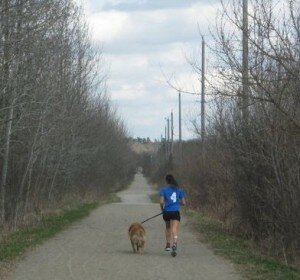 unning etiquette; my father taught Tanner from the beginning that when he was on a leash to always walk on my left side, to never bark and to leave his bathroom duty for the backyard (yes that’s right; he is the best dog ever!). However, not all dog owners will be this lucky. Dogs won’t know what to do on a run without your help. Aschwanden (2010) provided some suggestions on teaching your dog the ropes of running:
- Use a Leash: A leash allows you to have more control over your dog. “A gentle tug lets you guide Fifi’s body and attention where you want it” (Aschwanden, 2010).
- Reward Good Behaviour: Aschwanden (2010) suggests keeping your dog within three feet of you. You can reward your dog’s good behaviour with a treat (Aschwanden, 2010). Aschwanden (2010) suggests that eventually the run itself will be a reward to your dog. Tanner is always so excited to come running that I don’t even have to give him a dog cookie, he is happy enough to just coming along for the run and hear “Good boy Tan!”
- Do a Test Run: Aschwanden (2010) says to start your run with a lap or two around your neighbourhood to reinforcing this behaviour in a familiar environment. This will also ensure you will not get stranded with a bad behaviour dog.
- Teach Courtesy: Aschwanden (2010) suggests pulling off to side of the trail or sidewalk when strangers are passing and not letting them interact with your dog. With Tanner I usually just go between him and the stranger, run further up on the grass or run on the opposite side of the trail.
- Pick up the Dog Poop: When your dog poops on a run pick it up. My close friend also runs with her dog and she says her dog loves to poop in the middle of a 1 kilometer long bridge with garbage can only on either side of the bridge. Poor girl has to run it to the other side but she always picks it up. It is gross but it is the right thing to do. Personally, I am lucky; Tanner will not go to the washroom on a run. I have only seen him do it once during our 6 years of running.
Some Additional Dog Running tips:
Elliot (n.d.) and Harding (2012) also outlined some tips for running with your dog. I have outlined some of their additional tips below:
- Talk to your vet: Before you start exercising talk to your vet. Elliot (n.d.) suggest some breeds (for example, pugs) do not always have the capability to run. Harding (2010) suggests knowing your breed as some breeds (for example, shepherds, terriers, retrievers and other working dogs) are built for long distance running.
- Knowing your dog: Knowing your dog and its breed will allow you to understand and create a running routine that fits its capabilities. Also, Harding (2012) reminds you to listen to what your dog is saying; foaming at the mouth, panting, glazed eyes and slowing downs are signs your pal needs a break.
- Watch your dogs paws: Watch the surfaces you’re running on. Harding (2012) outlined that “hot blacktop, jagged ice, glass and other roadside debris can cause injuries.” Try to avoid surfaces that could cause your dogs paws pain.
- Stay Hydrated: Just like you need to stay hydrated so does your dog. Take plenty of water and offer it during your run. Elliot (n.d.) suggested cool but not cold water. Both Elliot (n.d.) and Harding (2012) outlined the importance of not letting your dog drink from puddles due to the high toxins in this water.
- Play it safe: Run with your dog in familiar areas because you will never know what you could encounter on a run.
- “Shit Happens”: Not everybody has a Tanner, so again, clean up that dog poop.
Resources:
Aschwanden, C. (2010). See spot run. Retrieved from http://www.runnersworld.com/running-tips/see-spot-run
Elliot, S. (n.d.). Top ten tips for running with your dog. Retrieved from http://www.howstuffworks.com/outdoor-activities/running/training/10-tips-running-with-dog.htm
Harding, D. (2012). 9 tips for running with your dog. Retrieved from http://www.mensfitness.com/leisure/outdoor/9-tips-for-running-with-your-dog

 I thought an important running tip this week would be how to begin your run. Should I stretch? What do I do before my run? Before you run, you do not necessarily need to stretch. The beginning of your run should be spent warming up, while the closing minutes should be spent cooling down. Roberts (2013) mentions that newer data does not support stretching before your run. Instead, it is suggested that you spend this time warming up or strength training to help reduce injury. This is why I have outlined the 5 minute brisk warm up walk before all the workouts.
 Additionally, this week Katie was diagnosed with exercise induced asthma. She described the Asthma while running as the feeling of something heavy sitting on her chest. Exercise Induced Asthma occurs when a person’s airways tighten and produce additional mucus (“Exercised-induced asthma”). Exercise can be a trigger but it doesn’t mean that you cannot exercise (“Exercised-induced asthma”). Katie’s doctor provided her with the proper medication to treat this condition. Understanding and treating her Asthma will assist her with reaching her goals. I am glad she found out about this condition early in our running program. Running will likely be easier now that she has it under control.

 Today, I helped my sister begin running. She has a goal to run a 5 kilometer race on July, 27th, 2013. This means she has approximately two months to prepare for this race. She is by no means a runner and has probably run a combined total of 10 kilometers in her entire life. So we are starting right from the beginning. I am sure there are others out here in her position, people who want to try running but don’t know where to start. Your first run is the first step towards becoming a runner. Join Katie and me on our journey of learning how to run 5km over the next two months.